No products in the basket.
What Recycled Cashmere Really Is (And Why It Is Not a Cheaper Alternative)
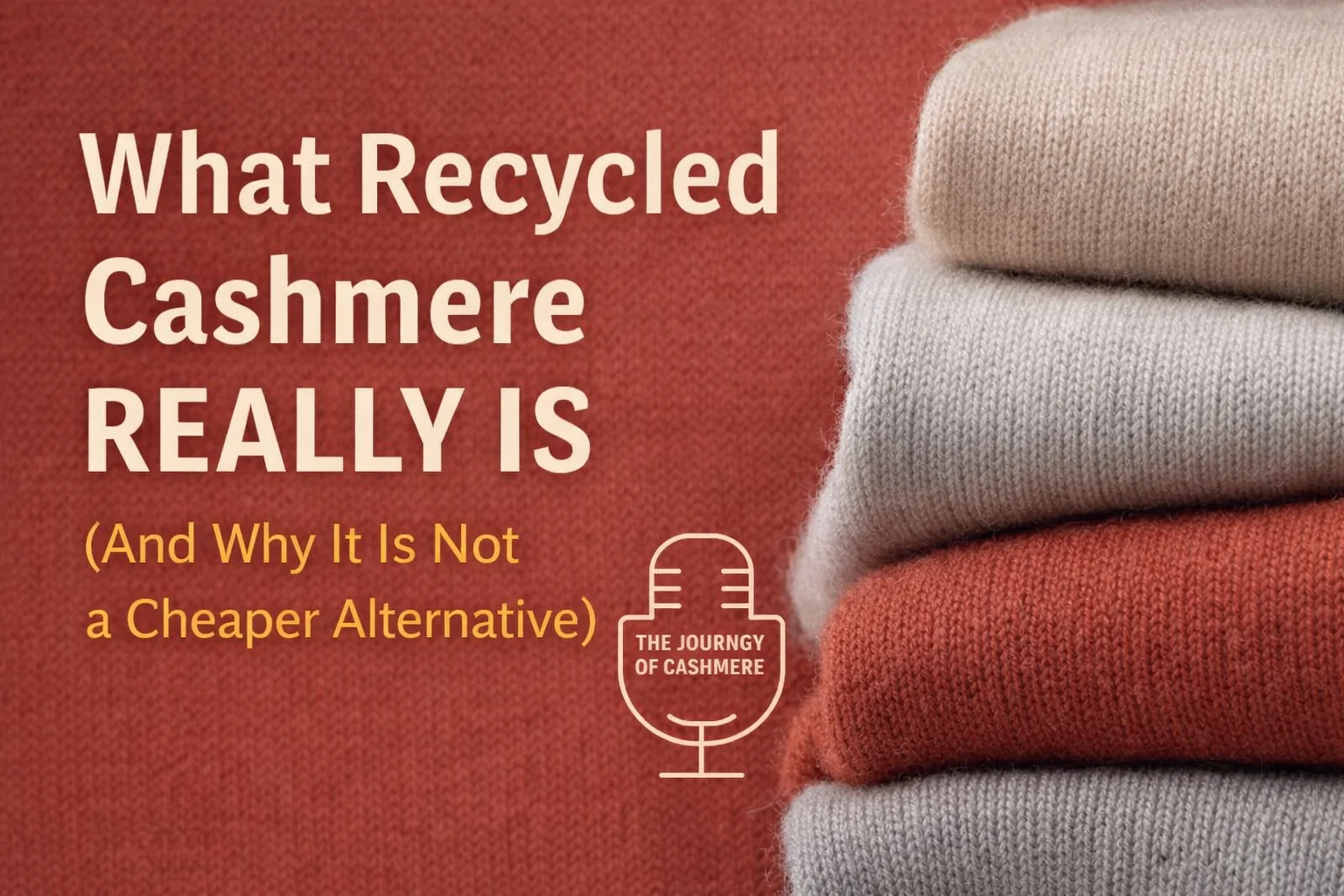
Recycled cashmere is one of the most misunderstood materials in the fashion industry.
Many people assume it is a “second-rate” option — a lower-cost compromise compared to virgin cashmere.
The reality is very different.
Recycled cashmere is not a low-cost alternative.
It is a technical, cultural and production choice rooted in more than one hundred years of textile expertise in Tuscany, Italy.
In this article, you will discover what recycled cashmere truly is, how it is made, and why its value is not lower — and in many cases, it is even higher.
What Is Recycled Cashmere?
Recycled cashmere (also called regenerated cashmere) is a fiber obtained from existing cashmere garments.
It is not synthetic.
It is not a “reconstructed” imitation fiber.
It is genuine cashmere that has already had a first life, carefully selected, mechanically reopened, carded and spun again into new yarn.
This process mainly takes place in Tuscany, particularly in the textile district of Prato, where textile recycling has been a well-established industrial and artisanal tradition for generations.
The journey looks like this:
Collection of used garments
Manual selection by composition and color
Mechanical reopening back into fiber
Carding
Spinning
Knitting production
Each phase is delicate.
Each mistake affects the final result.
Why It Is Not a Cheap Product
One of the most common misconceptions is that recycled cashmere should cost less.
In reality, producing high-quality recycled cashmere can be more complex — and sometimes more expensive — than working with virgin cashmere.
Here’s why.
1️⃣ Manual Selection
There are no machines capable of recognizing cashmere by touch the way an experienced textile sorter (cenciaiolo) can.
Every garment is checked by hand.
From 100 kg of collected garments, often only 10–15 kg of usable cashmere fiber remain.
The yield is extremely low.
2️⃣ Shorter Fibers
During the mechanical reopening process, fibers become shorter compared to virgin cashmere.
This requires:
careful yarn twist adjustments
specific spinning calibrations
slower production speeds
Recycled yarn requires technical expertise and experience.
3️⃣ Every Batch Is Different
Virgin cashmere is standardized.
Recycled cashmere is not.
Each batch has:
different behavior
unique yield
natural color variations
This means greater quality control and deeper know-how.
Not a Compromise — A Conscious Choice
Recycled cashmere is not created to reduce costs.
It exists to:
reduce environmental impact
enhance existing material
preserve artisanal tradition
create unique natural melange colors
maintain a local, transparent supply chain
It represents a modern form of luxury — more conscious and responsible.
Many customers, after touching high-quality recycled yarn, realize that:
the hand feel is rich and full
the warmth is identical
the structure can be more stable
the natural melange effect is deeper and more refined
Recycled does not mean “less.”
It means different.
The True Value: Culture and Territory
Recycled cashmere is the result of a short and integrated supply chain unique in the world.
In Tuscany, all production stages are located within a small geographic area:
selection
carding
spinning
knitting
finishing
This ensures control, expertise and quality.
It is not only a technical matter.
It is a cultural one.
Learn More in the Podcast
If you would like to explore the full process, meet the people behind it and understand the Tuscan supply chain in depth, you can listen to Season 1 of the podcast “The Journey of Cashmere” on YouTube:
👉 https://www.youtube.com/watch?v=vvdApv_L6Kk&list=PLFyPJyKp8KjHeUFY1tem7WSAOXD8aB4jM&index=21
In the podcast, you will discover:
the complete selection process
differences between virgin and recycled cashmere
the real cost structure
the truth about greenwashing
the future of regenerated fibers
Recycled cashmere is not a shortcut.
It is a complex, technical and artisanal process.
It is not a cheap alternative.
It is a value-driven choice.
And above all, it is a story that deserves to be understood.
Follow Us on Youtube

Latest products
-
 Yarn 2/28 100% Cashmere color lubecca cones 520 gr Original price was: € 88,82.€ 76,13Current price is: € 76,13.
Previous lowest price was € 76,13.
-
 Yarn 2/28 100% Cashmere color kensington cones 500 gr Original price was: € 85,40.€ 73,20Current price is: € 73,20.
Previous lowest price was € 73,20.
-
 Yarn 2/28 100% Cashmere color iron cones 520 gr Original price was: € 88,82.€ 76,13Current price is: € 76,13.
Previous lowest price was € 76,13.
-
 Yarn 2/28 100% Cashmere color light grey cones 610 gr Original price was: € 103,70.€ 89,30Current price is: € 89,30.
Previous lowest price was € 89,30.
- Yarn 2/28 100% Cashmere color light grey cones 610 gr Original price was: € 103,70.€ 89,30Current price is: € 89,30.
Previous lowest price was € 68,81.