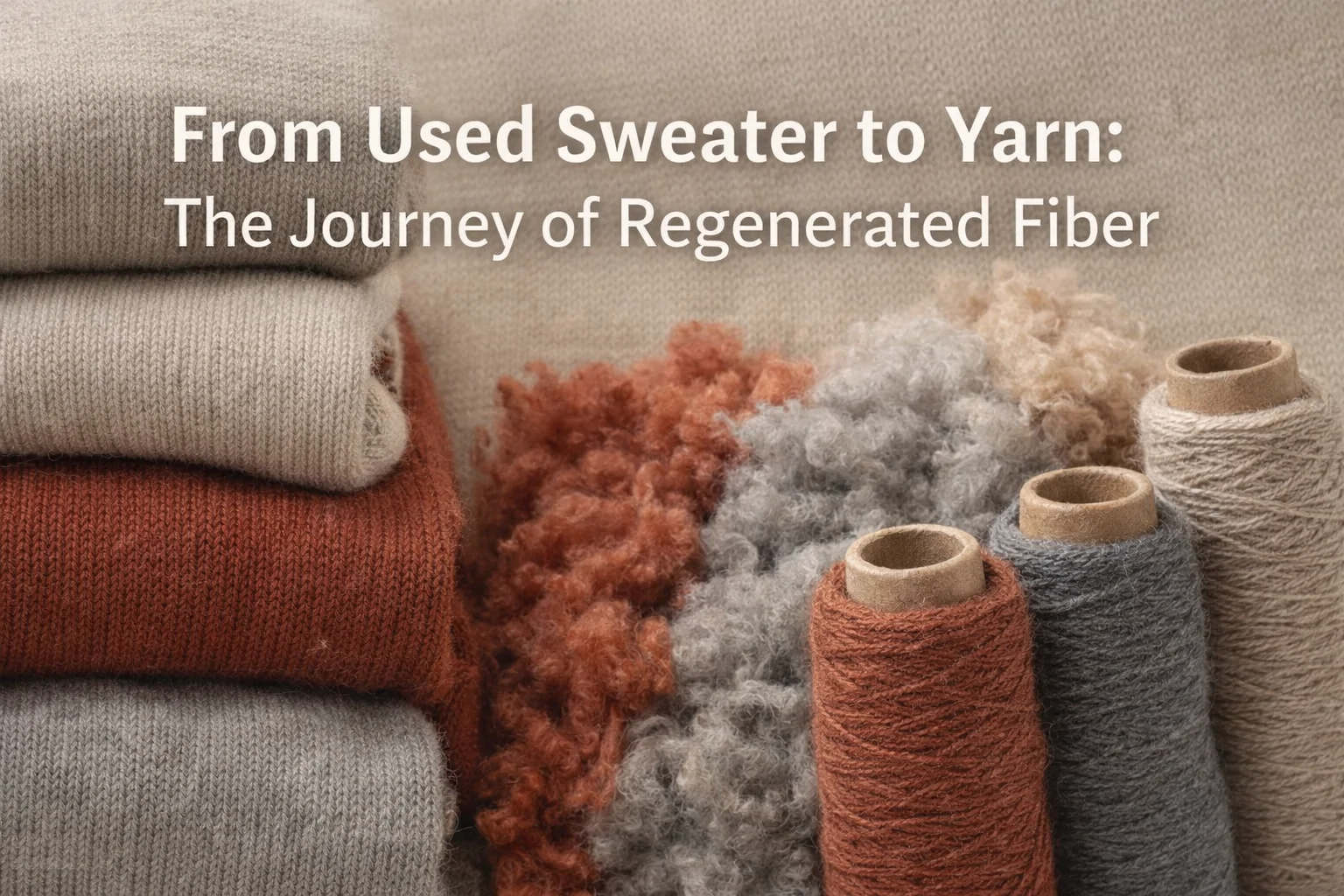
What really happens to an old cashmere sweater once we stop wearing it?
Does it end up in a landfill?
Is it destroyed?
Or can it be reborn?
In the heart of Tuscany, in the textile district of Prato, there is a unique process that allows a cashmere garment to live a second life. It is not magic. It is technique, experience, industrial culture and artisanal know-how.
This is the journey of regenerated fiber.
But first, check out our recycled cashmere yarns by clicking here.
And when you’re done reading this article, learn more by listening to the recycled cashmere podcast by clicking here.
1️⃣ It All Starts with Selection: The Work of the Textile Sorter
The first step is the most delicate: selection.
Used garments arrive in large quantities. Not everything labeled “cashmere” is truly 100% cashmere. Many pieces are blends, others are worn out, and some have unclear compositions.
This is where a historic figure of the Prato district comes in: the textile sorter (known locally as the cenciaiolo).
The sorter recognizes cashmere by touch.
No advanced machines — just experienced hands.
They check:
real fiber composition
presence of synthetic fibers
fiber quality
level of wear
color
Selection is manual and extremely slow.
From 100 kg of collected garments, only a small portion becomes usable raw material.
This is the first reason why recycled cashmere is not an “easy” material.
2️⃣ Sorting by Color: The Secret Behind Natural Melanges
Once selected, garments are divided by color.
This is not just “red” or “gray.”
It includes:
deep burgundy
light camel
melange gray
forest green
natural browns
Color sorting is essential because high-quality recycled cashmere is often produced without re-dyeing.
The final color comes from blending already-colored garments.
This creates unique tones that cannot be industrially replicated.
Each batch is slightly different.
Each color tells a story.
3️⃣ Opening: Returning the Garment to Fiber
After selection, the sweater is no longer a garment.
It is mechanically opened back into fiber.
The knitted structure is broken down and reduced to loose fibers.
This stage is extremely delicate.
Too much mechanical force breaks the fibers.
Too little reduces efficiency.
Technical expertise makes the difference between mediocre yarn and excellent yarn.
During this phase, the fiber becomes shorter compared to virgin cashmere.
This affects all subsequent steps.
4️⃣ Carding: Cleaning and Aligning the Fibers
The opened fiber is then carded.
Carding serves several purposes:
further separating the fibers
removing remaining impurities
aligning and homogenizing the mass
preparing the material for spinning
The carding stage is the heart of the process.
A mistake here compromises yarn uniformity.
This is where quality begins.
5️⃣ Spinning: Transforming Fiber into Yarn
The carded fiber is transformed into yarn.
This is a highly technical stage, especially with recycled cashmere.
Why?
Because the fibers are shorter than virgin cashmere.
This requires:
adjusted twist levels
controlled tension
slower production speeds
careful monitoring of yarn strength
A good recycled yarn should not feel weak or irregular.
It must be stable, compact and pleasant to the touch.
The difference between excellent and mediocre recycled cashmere lies here.
6️⃣ Quality Control: Every Batch Is Unique
Virgin cashmere tends to be standardized.
Recycled cashmere is not.
Each batch is different.
Producers must check:
yarn count
uniformity
presence of knots
performance during knitting
behavior under tension
This requires an artisanal mindset even in an industrial setting.
Full standardization is impossible.
But this uniqueness is precisely what makes recycled cashmere special.
7️⃣ From Yarn to Knitwear
The regenerated yarn is then used in knitwear production.
Important variables include:
machine gauge
stitch structure
knitting tension
finishing treatments
Recycled yarn behaves differently from virgin yarn.
Those who work with it must understand its characteristics.
The final finishing process (controlled washing and steaming) stabilizes the garment and enhances its hand feel.
8️⃣ A Short Supply Chain, Unique in the World
The true value of this journey is not only technical.
It is geographical.
In the Tuscan textile district, all production stages happen within a few kilometers:
selection
opening
carding
spinning
knitting
finishing
This ensures:
continuous control
direct communication between companies
rapid adjustments
consistent quality
It is not just a production process.
It is an ecosystem.
9️⃣ Why This Process Is Truly Sustainable
Sustainability is not a slogan.
In recycled cashmere, it means:
no new goat farming
drastically reduced environmental impact
reuse of existing material
local supply chain
reduced transportation
But above all, it means preserving and enhancing historic textile expertise.
An old sweater is not waste.
It is raw material.
The journey of regenerated fiber shows that value does not lie only in novelty, but in transformation.
Recycled cashmere is not a compromise.
It is a balance between tradition, technique and responsibility.
And every yarn carries a story that began long before its second life.