

What does "yarns to be processed" mean?

In the world of yarns – especially those intended for artisanal and industrial knitting – it is common to read the phrase “yarns to be treated”.
But what does it really mean? And above all: what kind of treatment is needed and how is it done?
Let's clarify, once and for all.
What are yarns to be treated
A yarn to be treated is a yarn that has not yet undergone the final finishing treatments.
In practice, it is a "raw" or semi-finished yarn, intended to be processed (knitted or woven) and subsequently finished on the final garment.
These yarns:
-
have not yet been washed
-
are not felted or stabilized
-
may appear stiffer, duller, or more irregular
-
express their best only after treatment
👉 It's a technical choice, not a defect.
 Why yarns to be treated exist
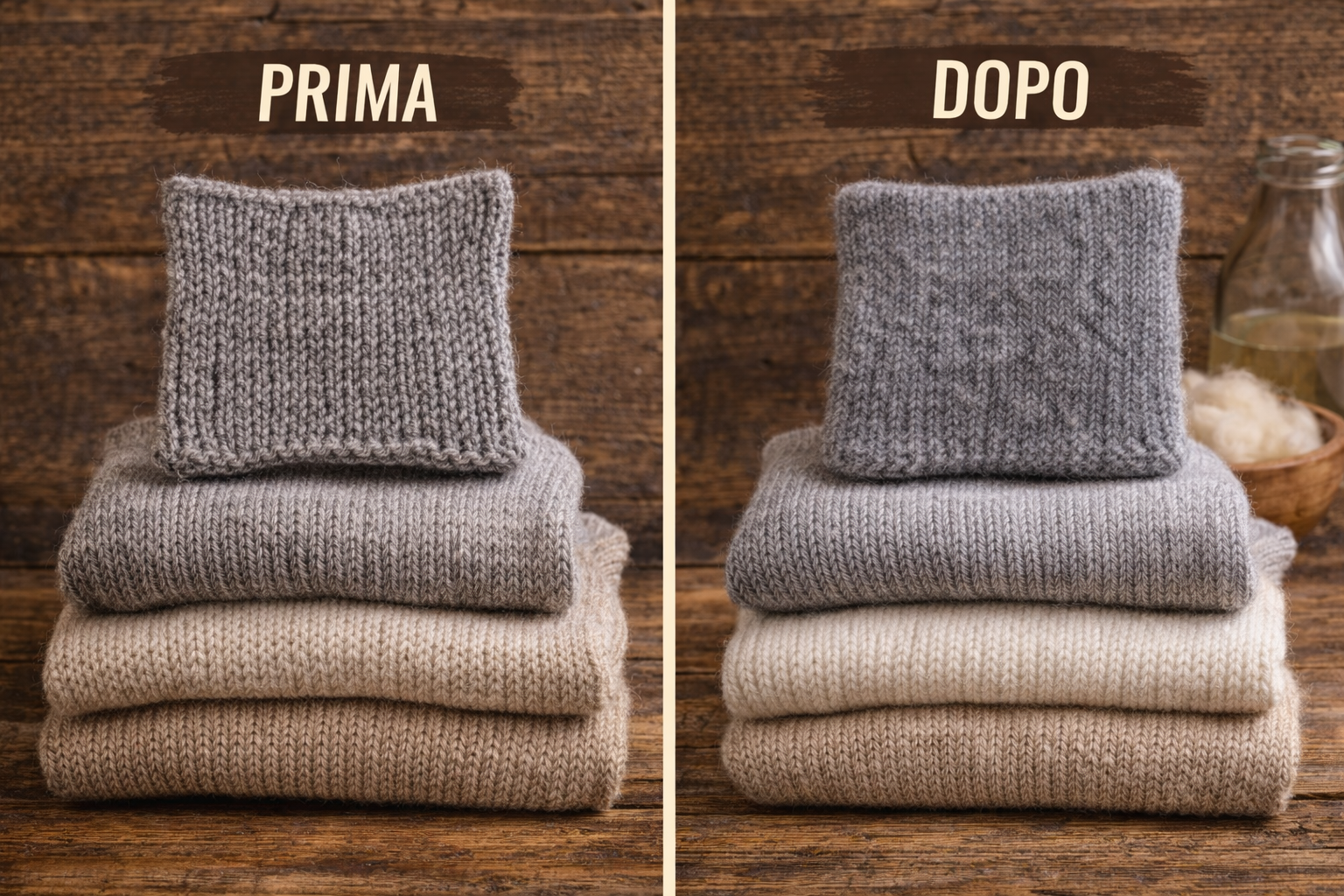
Yarns to be treated exist because treatment on the finished garment allows for superior results compared to treating the yarn itself.
In particular, they allow for:
-
greater final softness
-
better aesthetic appearance of the knit stitch
-
greater compactness or "bloom" of the garment
-
control of hand and volume
They are widely used for:
-
cashmere
-
recycled cashmere
-
wool
-
noble blends (wool/silk, wool/cashmere, etc.)
How a yarn to be treated appears (before)
Before treatment, a yarn to be treated may seem:
-
drier to the touch
-
less soft
-
visually "flatter"
-
with an undefined knit stitch
⚠️ This often causes confusion for those unfamiliar with the process and who evaluate the yarn before its natural completion.
What the yarn treatment consists of (on the garment)
The treatment is not done on the yarn on the bobbin, but on the finished garment (sweater, scarf, accessory, sample)
1. Washing
The garment is washed in water with delicate detergents specific for natural fibers.
It serves to:
-
eliminate spinning and processing oils
-
relax the fiber
-
begin the opening of the yarn
2. Felting (when foreseen)
Felting is a controlled mechanical action that opens the fiber.
Main effects:
-
the garment compacts slightly
-
the yarn "blooms"
-
softness increases
-
thermal insulation improves
⚠️ Not all yarns require felting: it depends on the count, fiber, and desired result.
3. Rinsing and stabilization
After treatment, the garment is:
-
rinsed
-
stabilized to correct dimensions
-
prepared for drying
This step is crucial to prevent future deformation.
4. Drying and resting
Drying occurs:
-
flat
-
or in specific low-temperature machines
The garment then needs to rest, so that the natural fiber can fully stabilize.
How the yarn is after treatment
After treatment, the change is evident:
-
softer
-
fuller
-
warmer
-
more defined knit stitch
-
final appearance consistent with the quality of the fiber
👉 It is at this point that the yarn shows its true value.
Yarns to be treated ≠ defective yarns
It is important to emphasize this clearly:
A yarn to be treated is not a defective yarn,
it is a yarn designed for a correct production process.
Evaluating it before treatment is like judging a garment before the final wash.
When to choose a yarn to be treated
Choose a yarn to be treated if:
-
you knit (by hand or machine)
-
you produce finished garments
-
you want maximum control over the final result
-
you know (or want to learn) the finishing process
If, on the other hand, you are looking for a yarn ready to use without treatments, then you need a yarn that has already been treated upstream.
Yarns to be treated are part of the tradition of quality textile and knitwear.
They require knowledge, but they repay with significantly superior results.
Understanding what they are and how they work means taking a step forward in yarn culture.
IF YOU WANT TO KNOW HOW TO TREAT YOUR WORK AT HOME CLICK HERE.
I RECOMMEND YOU ALWAYS MAKE A SWATCH AND WASH IT BEFORE MAKING THE FINAL WORK.


