How to Choose Needle Size for Various Yarns
When you buy yarn in skeins, the ball band usually indicates the recommended needle size. Of course, this is just a guideline that helps but doesn't eliminate the need to make a swatch. The same yarn could be worked with different needles, depending on your "knitting tension" ("loose" or "tight"). These are our personal characteristics, some pull the yarn more, some less. When you buy yarn on cones or recycle wool by unraveling old sweaters, you probably rely on your experience and do some testing.
What should beginners do if they have no experience? Here's a post for you. I want to give you a very, very simple tip that will help you choose the right needles.
What you'll need is a knitting needle gauge. There are several types available on the market. In my opinion, it's a very useful tool, especially for those who use circular needles (here's a free course
in Italian and
in English). Those who are used to long needles find the size on the end, but for those who use circular needles, it's an absolutely essential tool, as this information is usually missing.
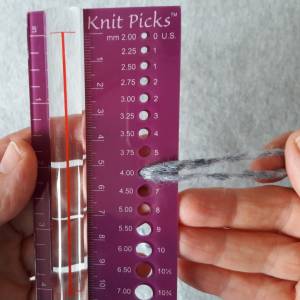
Pass two strands of your yarn through one of the holes and find the right one: the yarn should not be pulled tight and should fill the hole softly without leaving too much free space. There you go, you already have the first indication of what needle size to use. Now make a swatch with the needle size indicated next to the hole. If it seems too "loose" to you, take needles one size smaller; if, on the other hand, it seems too "tight," choose larger ones. After a few tries, you'll better understand which needles will be right for "your tension."
Lately, I've been talking about the interesting opportunities we can have using fine machine yarns (read
here). How to proceed in this case? After you've purchased a machine yarn, you need to decide how many strands you want to work with. This choice depends, of course, on the thickness of the yarn and what you want to create (usually 3 to 5 strands are used for hand knitting). Remember that, to choose the needle size, you need to double the number of strands before passing them through a hole.
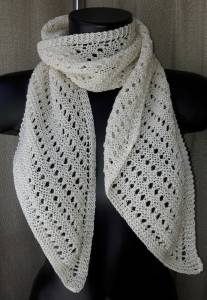
Let me give you a practical example. The scarf you see above (described
here) was worked with 3 strands of
cashmere and silk. To decide which needle size to choose, I had to double the number of strands, so I passed 6 strands through the hole.


Afterward, of course, I had to make a swatch.
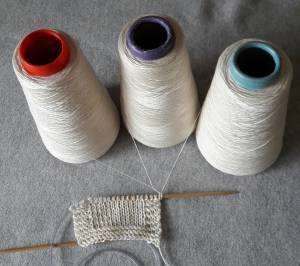
If you want to work with 4 strands, you'll need to pass 8 through a hole, and so on.
Hoping this post is useful to you, I wish you... happy testing :-).


