
How to Calculate the Amount of Cashmere for a Knitting Project – Part II: Scarves and Stoles
Before reading today's post, I recommend you read this (it's the first part of the topic I'll be discussing below).
You've probably already noticed that the yardage of the yarn is much more important than its weight. When someone asks me, "how much wool do I need to buy to make a scarf?", I don't know how to answer. It all depends on the type of wool, especially the grist of the yarn. A 50-gram ball could have approximately 30 to 300 meters in length. The 30-meter one will be very thick, the 300-meter one very thin.
In this post, I want to help you by simplifying the calculations.
The table below approximately indicates how many stitches are in a 10 cm stockinette stitch swatch and how many meters of yarn will be needed to make a scarf or a stole.
I remind you that these numbers represent an average: those who knit tightly will have more stitches, while those who knit loosely might have fewer.
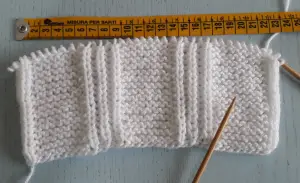
 is made of garter stitch strips (knit stitches) alternating with garter stitch strips (purl stitches).
The number of stitches to cast on must be divisible by 20 + 10 (for the last strip) + 6 (for 2 tubular edges).
1 strip of 10 garter stitches is approximately 5 cm (needles number 4 – 4.5).
Row 1: k3, *k10, p10*, repeat from * to *, k13
Row 2: p3, *k10, p10*, repeat from * to *, k10, slip the last 3 stitches onto the right needle without working, leaving the yarn in front
Row 3: k3, *k10, p10*, repeat from * to *, k10, slip the last 3 stitches onto the right needle without working, leaving the yarn in back
Row 4: p3, *k10, p10*, repeat from * to *, k10, slip the last 3 stitches onto the right needle without working, leaving the yarn in front
Repeat rows 3 and 4.
Swatch 2
is made of garter stitch strips (knit stitches) alternating with garter stitch strips (purl stitches).
The number of stitches to cast on must be divisible by 20 + 10 (for the last strip) + 6 (for 2 tubular edges).
1 strip of 10 garter stitches is approximately 5 cm (needles number 4 – 4.5).
Row 1: k3, *k10, p10*, repeat from * to *, k13
Row 2: p3, *k10, p10*, repeat from * to *, k10, slip the last 3 stitches onto the right needle without working, leaving the yarn in front
Row 3: k3, *k10, p10*, repeat from * to *, k10, slip the last 3 stitches onto the right needle without working, leaving the yarn in back
Row 4: p3, *k10, p10*, repeat from * to *, k10, slip the last 3 stitches onto the right needle without working, leaving the yarn in front
Repeat rows 3 and 4.
Swatch 2
 is made of garter stitch strips (knit stitches) alternating with English rib strips.
Cast on 40 stitches (needles number 4 – 4.5)
Row 1: k3, * 8-stitch garter stitch strip (= k8), k1, p1, k1, p1, k1,* repeat from * to *, 8-stitch garter stitch strip (= k8), k3.
Row 2: p3, * 8-stitch garter stitch strip (= k8), p1, k1, p1, k1, p1,* repeat from * to *, 8-stitch garter stitch strip (= k8), tubular edge (slip the last 3 stitches onto the left needle without working, leaving the yarn in front).
Row 3: tubular edge (k3), * 8-stitch garter stitch strip (= k8), 5-stitch English rib strip (= knit all knit stitches (3) by inserting the needle into the knit stitch below the one on the needle, purl stitches are purled)*, repeat from * to *, 8-stitch garter stitch strip (= k8), tubular edge (slip the last 3 stitches onto the left needle without working, leaving the yarn in back).
Row 4: tubular edge (p3), *8-stitch garter stitch strip (= k8), 5-stitch English rib strip (= knit all knit stitches (2) by inserting the needle into the knit stitch below the one on the needle, purl stitches are purled)*, repeat from * to *, 8-stitch garter stitch strip (= k8), tubular edge (slip the last 3 stitches onto the left needle without working, leaving the yarn in front).
Repeat rows 3 and 4 until the desired length is reached.
I hope this post will help you calculate the amount of cashmere needed to create a beautiful scarf.
Happy knitting and... see you next time!
Alicja Kwartnik for Hircus Filati
is made of garter stitch strips (knit stitches) alternating with English rib strips.
Cast on 40 stitches (needles number 4 – 4.5)
Row 1: k3, * 8-stitch garter stitch strip (= k8), k1, p1, k1, p1, k1,* repeat from * to *, 8-stitch garter stitch strip (= k8), k3.
Row 2: p3, * 8-stitch garter stitch strip (= k8), p1, k1, p1, k1, p1,* repeat from * to *, 8-stitch garter stitch strip (= k8), tubular edge (slip the last 3 stitches onto the left needle without working, leaving the yarn in front).
Row 3: tubular edge (k3), * 8-stitch garter stitch strip (= k8), 5-stitch English rib strip (= knit all knit stitches (3) by inserting the needle into the knit stitch below the one on the needle, purl stitches are purled)*, repeat from * to *, 8-stitch garter stitch strip (= k8), tubular edge (slip the last 3 stitches onto the left needle without working, leaving the yarn in back).
Row 4: tubular edge (p3), *8-stitch garter stitch strip (= k8), 5-stitch English rib strip (= knit all knit stitches (2) by inserting the needle into the knit stitch below the one on the needle, purl stitches are purled)*, repeat from * to *, 8-stitch garter stitch strip (= k8), tubular edge (slip the last 3 stitches onto the left needle without working, leaving the yarn in front).
Repeat rows 3 and 4 until the desired length is reached.
I hope this post will help you calculate the amount of cashmere needed to create a beautiful scarf.
Happy knitting and... see you next time!
Alicja Kwartnik for Hircus Filati
|
Approximate number of stitches in 10 cm (stockinette stitch) |
Small scarf 15 x 100 cm (approx) |
Large scarf 25 x 140 cm (approx) |
Stole 50 x 280 cm (approx) |
|
12 |
104 meters |
243 meters |
486 meters |
|
16 |
148 meters |
344 meters |
688 meters |
|
20 |
186 meters |
434 meters |
868 meters |
|
24 |
264 meters |
614 meters |
1228 meters |
|
28 |
290 meters |
676 meters |
1352 meters |
-
-
Needle size
Approximate number of stitches / 10 cm swatch (stockinette stitch)
2.25 – 3.25
31 – 26
3.25 – 3.75
25 – 28
3.75 – 4.5
28 – 20
4.5 – 5.5
20 – 16
5.5 – 8
15 – 12
-
is made of garter stitch strips (knit stitches) alternating with garter stitch strips (purl stitches).
The number of stitches to cast on must be divisible by 20 + 10 (for the last strip) + 6 (for 2 tubular edges).
1 strip of 10 garter stitches is approximately 5 cm (needles number 4 – 4.5).
Row 1: k3, *k10, p10*, repeat from * to *, k13
Row 2: p3, *k10, p10*, repeat from * to *, k10, slip the last 3 stitches onto the right needle without working, leaving the yarn in front
Row 3: k3, *k10, p10*, repeat from * to *, k10, slip the last 3 stitches onto the right needle without working, leaving the yarn in back
Row 4: p3, *k10, p10*, repeat from * to *, k10, slip the last 3 stitches onto the right needle without working, leaving the yarn in front
Repeat rows 3 and 4.
Swatch 2
is made of garter stitch strips (knit stitches) alternating with English rib strips.
Cast on 40 stitches (needles number 4 – 4.5)
Row 1: k3, * 8-stitch garter stitch strip (= k8), k1, p1, k1, p1, k1,* repeat from * to *, 8-stitch garter stitch strip (= k8), k3.
Row 2: p3, * 8-stitch garter stitch strip (= k8), p1, k1, p1, k1, p1,* repeat from * to *, 8-stitch garter stitch strip (= k8), tubular edge (slip the last 3 stitches onto the left needle without working, leaving the yarn in front).
Row 3: tubular edge (k3), * 8-stitch garter stitch strip (= k8), 5-stitch English rib strip (= knit all knit stitches (3) by inserting the needle into the knit stitch below the one on the needle, purl stitches are purled)*, repeat from * to *, 8-stitch garter stitch strip (= k8), tubular edge (slip the last 3 stitches onto the left needle without working, leaving the yarn in back).
Row 4: tubular edge (p3), *8-stitch garter stitch strip (= k8), 5-stitch English rib strip (= knit all knit stitches (2) by inserting the needle into the knit stitch below the one on the needle, purl stitches are purled)*, repeat from * to *, 8-stitch garter stitch strip (= k8), tubular edge (slip the last 3 stitches onto the left needle without working, leaving the yarn in front).
Repeat rows 3 and 4 until the desired length is reached.
I hope this post will help you calculate the amount of cashmere needed to create a beautiful scarf.
Happy knitting and... see you next time!
Alicja Kwartnik for Hircus Filati