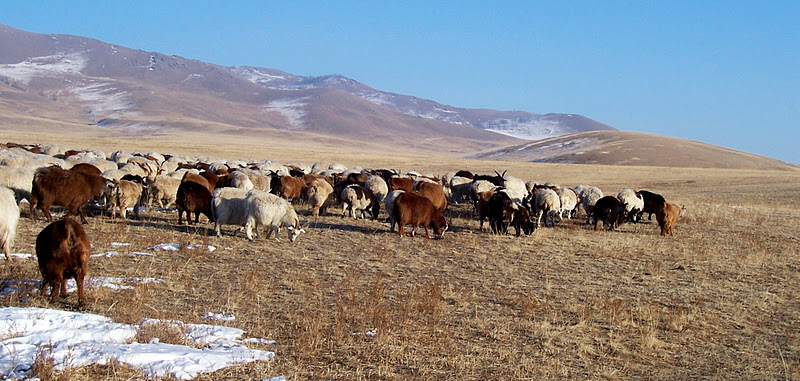
Kashmir is first and foremost the name of a province in India. Cashmere, or kashmir, is a textile fiber made from the hair of the hircus goat, named after the animal's region of origin.
The wool of
hircus goats is very soft, and silky and velvety to the touch, which further enhances its value. When worn, it provides a warm and fluffy sensation, effectively protecting against temperature fluctuations. This is due to the "duvet," the thinner part of the undercoat, like a downy hair, which naturally serves this purpose, protecting the goat from thermal excursions by thermally regulating its body.
The goats live in the mountainous regions and Asian plateaus. Nowadays, only small, insignificant quantities of cashmere fiber are produced in the Indian province of Kashmir. The other producing countries are mainly China, Iran, Mongolia, and Afghanistan. The particular climatic conditions, the strong temperature fluctuations between day and night in these areas, favor the development of the downy hair called duvet. This downy hair has the exceptional characteristic, like all animal fibers (but this one more than any other), of thermo-regulating the animal's body with respect to the external environment, protecting it from both low and high temperatures.
From the Kashmir region, which as we mentioned is a province of India, cashmere wool was exported to Europe starting from the early 1800s.
While the thinnest and finest part is the downy hair of the undercoat and is called duvet, meaning the soft, woolly underlayer, the coarser part with stiff, rough hairs comes from the outer coat and is called 'garré'. To collect it, the coat is hand-combed during the molting season, which occurs in spring. The production per animal can average between 100 and 200 grams of fine hair.
www.florencecashmereyarn.com
