

How to Calculate the Amount of Cashmere for a Knitting Project Part IV: Gloves, Hats, Socks

Lately, I've written a few posts on how to calculate the amount of yarn for a knitting project:
Part I: General information with a practical example
Today I want to conclude this topic by talking about gloves, hats, and socks.
I'm sure that everyone who knits or crochets experiences the same thing: after a while, our homes are full of different yarns, but not enough for a full garment. We'd like to use them, but often don't know how.
A beautiful ball of cashmere might be enough for a hat… but what if you start and it's not enough? If you bought it from the Hircus Filati website, you'll know that it's not possible to buy another one that's exactly the same, and what's more, from the same dye lot. These yarns come from stock, produced by the best Italian spinning mills, they are in small quantities and constantly changing.
These are real bargains: high quality at a low price.
Returning to today's post topic: how do you assess if the small amount of yarn you have is enough to make an accessory?
First of all, I want to give you a tip: immediately after purchasing the yarn, write down its weight, the approximate calculated yardage, and the recommended needle size (which you can find on the Hircus Filati website). Add a few meters of the yarn or, even better, a small sample to this information.
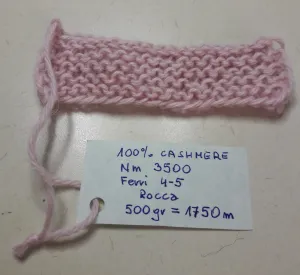
This small database will be very useful when you want to use your leftover yarn. Just weigh the ball and calculate the yarn's yardage.
Here's a practical example:
The yarn I bought weighed 500g and measured 1750m. A ball weighing 95g remained. The calculation I need to make is this:
(1750 m x 95 gr) : 500 = 332.5 m
Now, knowing how many meters the yarn measures, I can choose an accessory to make.
If you bought the yarn on a cone, remember that it is yarn to be treated.
Below you'll find tables with information on the yarn yardage needed to make gloves, hats, and socks. I remind you that, as I already explained in previous posts, this is an approximate calculation for stockinette stitch. If you have "tight tension" or want to make fancy stitches, you need to increase the amount of yarn.
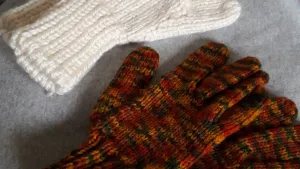
Gloves
|
Approximate number of stitches in 10 cm (stockinette stitch) |
hand circumference: 18 cm |
hand circumference: 19 cm |
hand circumference: 20.5 cm |
hand circumference: 21.5 cm |
hand circumference: 23 cm |
|
20 |
101 m |
120 m |
141 m |
161 m |
181 m |
|
24 |
143 m |
169 m |
199 m |
227 m |
256 m |
|
28 |
158 m |
186 m |
219 m |
250 m |
282 m |
|
31 |
173 m |
205 m |
241 m |
275 m |
310 m |
|
35 |
190 m |
225 m |
264 m |
302 m |
340 m |
Hats
|
Approximate number of stitches in 10 cm (stockinette stitch) |
circumference 42 cm (0-6 months) |
circumference 47 cm (6-18 months) |
circumference 51 cm 18 months-4 years |
circumference 53.5 cm adults S |
circumference 58.5 cm adults M-L |
|
16 |
61 m |
88 m |
114 m |
139 m |
170 m |
|
20 |
77 m |
112 m |
144 m |
175 m |
214 m |
|
24 |
109 m |
158 m |
203 m |
248 m |
303 m |
|
28 |
120 m |
174 m |
224 m |
273 m |
334 m |
|
31 |
132 m |
191 m |
246 m |
300 m |
367 m |
|
35 |
145 m |
210 m |
270 m |
330 m |
403 m |
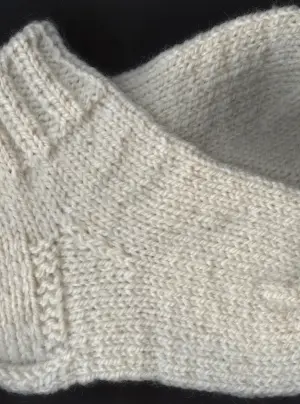
Socks
|
Approximate number of stitches in 10 cm (stockinette stitch) |
Child 2 – 8 years |
Size S women |
Size M – L women |
Size S men |
Size M – L men |
|
20 |
88 – 126 m |
172 m |
205 – 231 m |
255 m |
284 – 318 m |
|
24 |
124 – 179 m |
243 m |
290 – 327 m |
361 m |
401 – 450 m |
|
28 |
137 – 197 m |
268 m |
319 – 360 m |
397 m |
442 – 495 m |
|
31 |
150 – 216 m |
294 m |
351 – 395 m |
437 m |
486 – 545 m |
|
35 |
165 – 238 m |
323 m |
386 – 434 m |
480 m |
534 – 598 m |
I believe this calculation, although very approximate, is a valuable starting point, giving an idea of the amount of yarn needed to create an accessory.
-
-
Needle size
Approximate number of stitches / 10 cm swatch (stockinette stitch)
2.25 – 3.25
31 – 26
3.25 – 3.75
25 – 28
3.75 – 4.5
28 – 20
4.5 – 5.5
20 – 16
5.5 – 8
15 – 12
-
Hoping that this information will help you use your leftover cashmere and/or fine yarns purchased from Hircus Filati, I invite you to read my next post, where you will find some practical tips on how to combine various yarns.
See you soon,
Alicja Kwartnik for Hircus Filati


