

Moisture content in yarns

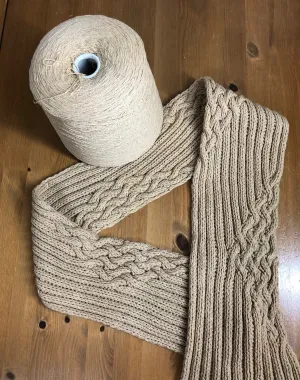 The moisture content in yarns, the conditioning of cashmere yarns (natural and fine yarns)
All textile fibers tend to absorb moisture from their surroundings. The determination of the moisture content of textile fibers is of paramount commercial importance. Wool fiber, for example, can absorb up to 30% by weight of water without any noticeable change to the touch compared to the fiber in hygrometric equilibrium conditions.
It is clear that in a commercial transaction involving a quantity of hygroscopic textile fiber (all fibers in general), the mass of the material found by simple weighing of the material cannot represent the "commercial weight" that should be subject to economic quotation.
Many factors influence yarn moisture, including temperature and the internal and external humidity of the premises where they are stored. Yarns can decrease or increase in weight based on the moisture they have absorbed or lost, even during transport from supplier to customer. In winter, the yarn will have a noticeable, but not excessive, increase in weight; the opposite is true in summer when the temperature is warmer and the climate is drier.
A cone of yarn can vary by 2, 3, or even 5% in weight from one day to the next based on changes in the air humidity level where it is stored.
For the stain removal of pure Cashmere yarns, it is very important that the process takes place in an environment with controlled temperature and humidity. When temperature and humidity are not controlled in the work environment, a high number of breakages can occur, compromising the success of the stain removal.
The physical-mechanical characteristics of textile fibers are varied, such as fineness, thermal stability, feltability, insulation, tenacity, elongation and breaking, elastic strength, etc.
Among these, the hygroscopicity of the textile material is very important.
Hygroscopicity is the ability of a textile fiber to absorb moisture from the environment.
Natural fibers, especially, have a certain degree (percentage) of moisture.
It is measured based on the maximum percentage of water that the fiber can absorb without appearing wet.
Wool and alginic fibers are the most hygroscopic.
For example, wool can absorb up to 33% of its weight without feeling wet.
Related to hygroscopicity is the moisture regain rate, which represents the maximum percentage of water that a fiber can contain to be commercialized and is measured as a percentage of the dry weight of the material, i.e., the amount of water absorbed at 20°C by 100 g of fiber, previously dried, then exposed for an hour to 65% humidity. Law 883 of 26.11.73 (and subsequent amendments - Directive 96/74/EC) defines the conventional values.
Humidity can vary from 18% for wool to 1.5% for synthetic fibers like polyester.
For example, silk has a regain rate of 11% and a humidity of 9.91%, while combed wool has a rate of 18.25% and a humidity of 15.43%.
It is necessary to ensure that yarns have constant and uniform humidity because due to the different quality of raw materials and the different environmental conditions in which the yarn is produced, it is never in optimal humidity conditions.
When the yarn passes from the spinning phase to the subsequent processing phase, it is essential to control the yarn's humidity, verifying its regain rate by treating it in such a way as to guarantee conventional values.
The system for conditioning the yarn consists of introducing it into special regain chambers where the yarn is subjected to humidification treatment with particular precautions.
To create a chamber, it is essentially necessary to keep in mind that the absorption of moisture by a textile fiber occurs in 3 distinct phases: the first rapid and superficial, the second slower and deeper, the third of diffusion due to an osmotic absorption of water that spreads inside the fiber itself, penetrating intimately and reaching all pores and capillary channels.
For these reasons, the regain chambers must ensure contact of the fiber with air humidity and not directly with water, because the yarn would get too wet and only superficially with an excessive increase in humidity, the result of which would be to obtain non-uniform humidification of the yarn.
The advantages obtained with good moisture regain are not only to guarantee a certain constant weight in the yarn packages but above all to improve the technical characteristics of the fiber. Furthermore, the yarn will be in ideal conditions to make it much easier to work with.


