

Short row technique

Short Row Technique
Today we'll talk about the short row technique. Don't worry, you won't have to cut your needles to shorten them 🙂 and you won't even have to buy new needles. The ones you have are perfectly fine, both long ones (if you prefer the traditional method) and circular ones (if you prefer the continental method). If you want to see the difference between the two methods, watch the second lesson of our free course.
Let's go back to short rows. This is a technique, a way of knitting, which consists of working only a part of the stitches you have on the left needle: this is why it's called a short row. Once the stitches are worked, you have to turn the work and knit the return row. It's harder to explain than to do. I'm sure you'll understand right away by watching the video.
As you've noticed, the short row technique is used to differentiate the length of the edges: one is longer than the other. Thanks to this setup, we can create: capes, shawls, sweaters with a round yoke, or hats, with designs (for example, braids) positioned along the edge.
The number of stitches to work in short rows is not random. It's calculated based on the difference between the long and short edges and, of course, based on the yarn you want to use to create a garment. The correct setup is a rather difficult and demanding task, which is why I advise against improvising. If you find a pattern you like in a magazine, you should first make a swatch and compare it with the swatch information provided in the pattern description. Only then can you start making it with the certainty that you won't have to undo it.
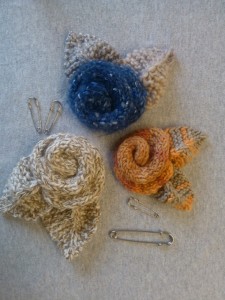
If you want to try this technique without committing to a too long project, just to satisfy your curiosity, you could make the flower you see in the photo next to it.
Cast on 9 stitches (the cast-on method doesn't matter) and always work in stockinette stitch, keeping chain edges.
Proceed as follows:
Row 1 – knit all stitches
Row 2 – purl all stitches
Row 3 – knit only 6 stitches, then turn the work
Row 4 – slip the first stitch purlwise and purl 5 more, then turn the work again
Continue repeating these 4 rows until one of the side edges is 7-8 times longer than the width of the strip.
The video will help you make the flower.
In the next video (third lesson), I'll show you how to sew the strip to create the flower.
I hope the short row technique is clearer now :-).
In the next three videos, I propose making leaves to match the flower, even if this is not part of the technique I'm talking about. However, a small extra suggestion seemed nice. In the video, you'll hear about garter stitch edges. If you don't know how to make them, check out one of our previous posts.


