

Fashion: the pros and cons of a constantly changing world.

I don't know about you, but I've never been particularly attached to fashion.
That doesn't mean I completely ignore it. Because, as with all things, there are pros and cons.
Let's look at them together, but let's focus on our soft world of knitting, wools, yarns, and everything our hands can create with needles and crochet hooks.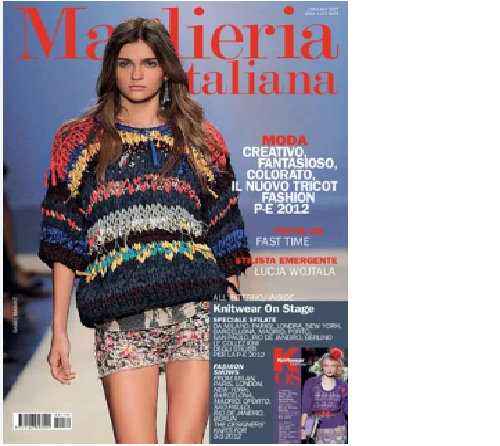
The pros of following fashion:
1. Following trends is definitely an important impetus; it ignites in us the desire to refresh our wardrobe, the desire to buy new wool and make a new sweater, a new scarf, a new hat… choosing new colors, ones that, perhaps, you’ve never considered before…
2. Following fashion trends encourages us to learn and experiment. It awakens our creative side. And that is something very, very valuable, regardless of whether we are beginners or experts in knitting.
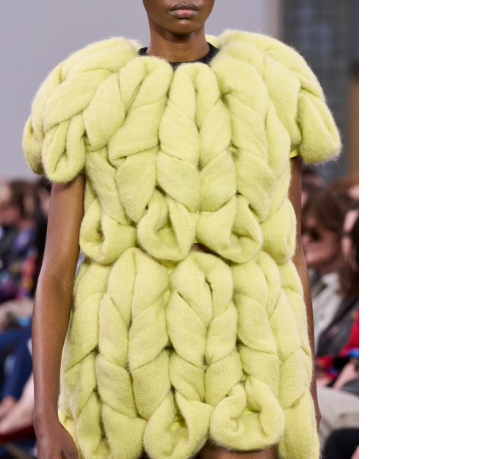
Let me give an example: if braids are in fashion (and this year all 3D knitwear, including braids, will be in fashion), if you want to follow fashion and don't know how to make them, you'll want to learn. Right? So fashion pushes you to learn.
If, on the other hand, you are an expert and know how to make braids very well, you can certainly invent original and personal patterns. Your creativity can be unleashed precisely thanks to new trends.
3. Following some fashion trends, even by making a simple accessory in wool: a scarf or a hat can give us a wonderful sense of security and self-esteem.
"I made it myself, with my own hands," you'll proudly tell anyone who compliments your creation.
There are also cons. Let's see what they are.
 1. To follow fashion to the letter, a lot of money is needed. How many of us can afford to change a lot in our wardrobe… and do it at least once a year? Very few. We usually try to enrich our closet with a new sweater. And that's fine!
I can't afford to buy a new coat every year, but I can always have a new scarf or hat. The costs of wool, even fine or even cashmere, or cashmere blend are not so high (check prices on the Hircus Filati website)… and those who know how to knit and crochet should consider themselves truly lucky.
2. The fashion industry is, unfortunately, among the most polluting in the world.
For example, the production of 1 kg of cotton has a very high cost. The data are truly alarming.
While researching, I discovered that producing 1 kg of cotton requires 7,000 to 29,000 liters of water… not to mention pesticides and fertilizers, and greenhouse gas emissions.
For this reason, I believe recycling (even creative recycling) is very important. I prefer to buy wool, cashmere, ecocashmere, or fine yarns such as, for example, alpaca, etc., which I can always reuse. Years ago, our grandmothers never threw away an old sweater; it was unraveled to recover the yarn and make another garment.
3. Social pressure: "you're not dressed fashionably, you might feel like a second-class person." Unfortunately, in certain environments, this pressure is significant. But we, common people, know that "clothes don't make the man," right? So let's start knitting and squash these feelings of inadequacy.
4. Fashion changes quickly, and what was in vogue a few years ago might be completely out of style today… so what do I do? Throw it away? Certainly not!!! Fortunately, in the world of knitting, these changes are not so radical. Just look at old fashion magazines.
The moral of the story? Let's observe fashion, yes, but let's only take what enriches us internally, what makes us feel good and cultivates our passion for knitting, and then… let's face it, some designs are truly extravagant.


